



CHN First Look: What the Census Bureau’s New Data Shows — and What It Doesn’t
The Census Bureau released its 2025 income, poverty, and health insurance data on September 15. Based on that data, CHN released our new First Look at Poverty, Hardship, and the Impact of Human Needs Programs, a one-pager highlighting what the data tells us about poverty and hardship — and what it doesn’t.
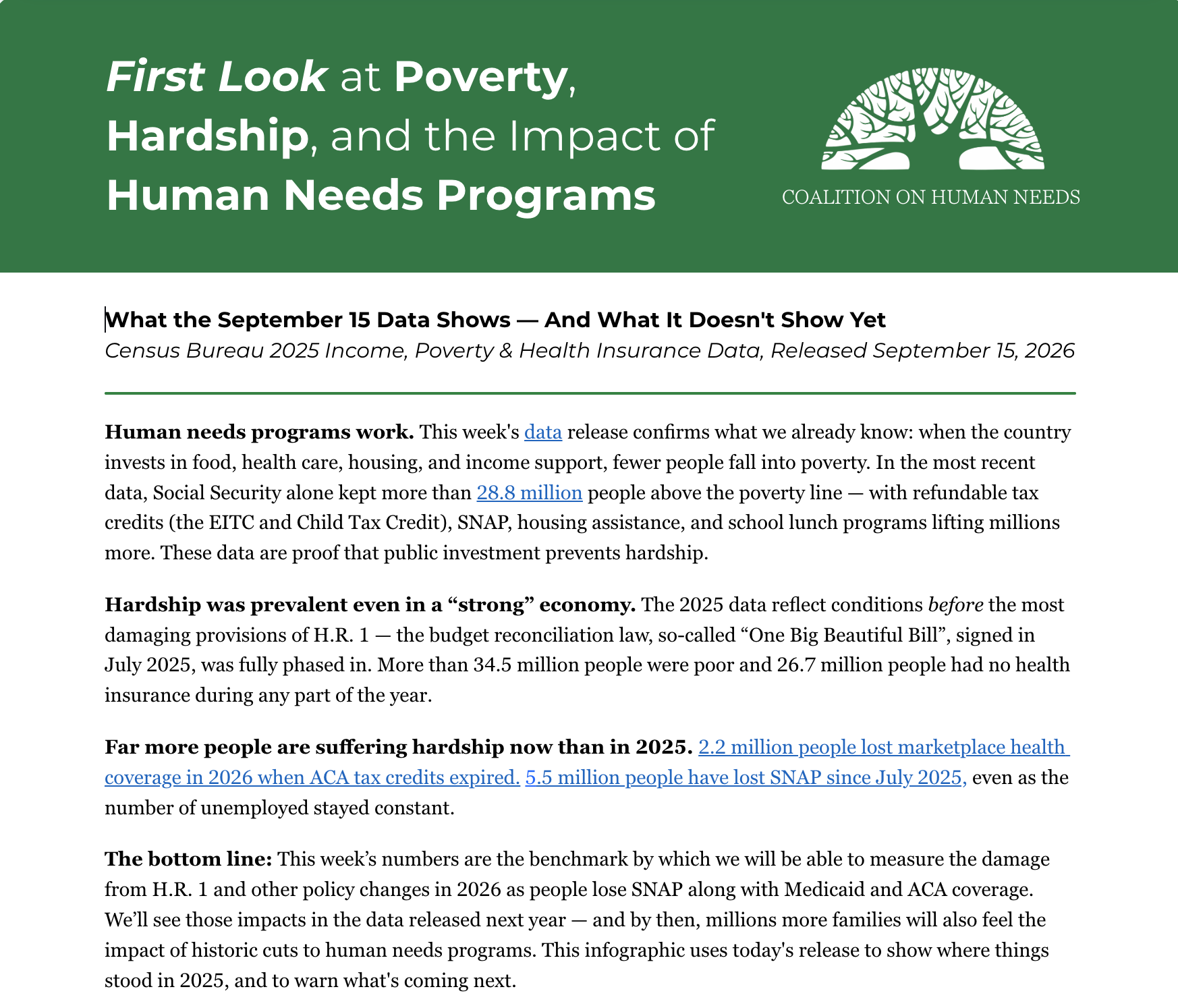
In 2025, more than 34.5 million people were poor and 26.7 million lacked health insurance at some point during the year. At the same time, human needs programs helped millions avoid poverty: Social Security alone kept more than 28.8 million people above the poverty line, with SNAP, housing assistance, school lunch, and refundable tax credits lifting millions more.
But the data largely reflects conditions before the most damaging provisions of H.R. 1 were fully phased in. The First Look highlights early signs of what has happened since, including the loss of 2.2 million people from marketplace health coverage and 5.5 million people from SNAP. The full effects will become clearer in next year’s Census data.
The document includes four tables that look at:
- How federal programs reduce poverty and hardship
- Poverty rates overall and by race, ethnicity, and family structure
- Changes in household income and economic inequality
- The income thresholds used to measure poverty in 2025
We hope this First Look will be a useful resource for advocates, organizations, and others working to understand the current state of poverty and economic hardship — and the importance of protecting and strengthening the programs people rely on. If you missed our webinar on the data release, you can now access the webinar recording and closed captions.
Please feel free to share the First Look with your networks.
Subscribe: