



Fact of the Week: Number of Children Benefiting from Federal Low-Income Child Care Program at 16 Year Low
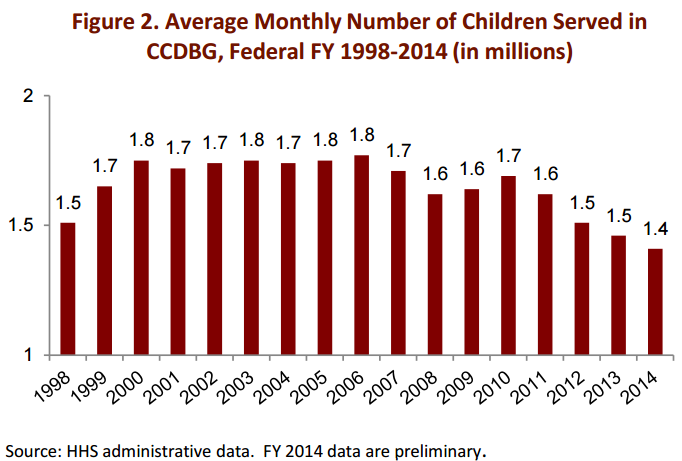
The number of children receiving child care funded by the Child Care and Development Block Grant (CCDBG) fell to a 16-year low, according the Center for Law and Social Policy (CLASP). The CCDBG is the primary source of federal funding for helping low-income families pay for child care, with half of the families who receive benefits living below the poverty level.
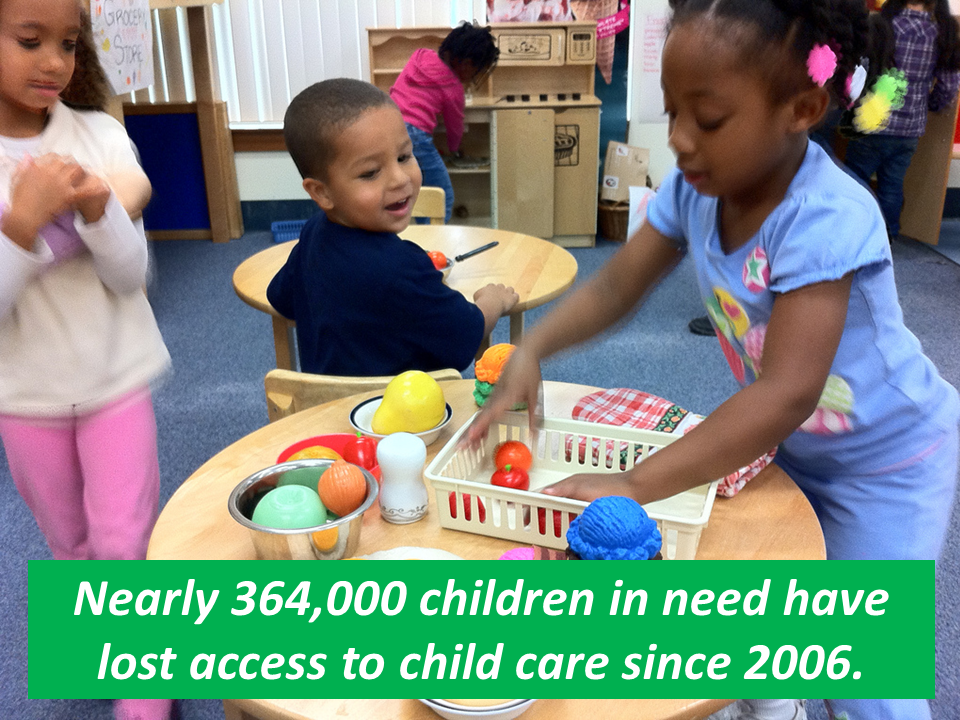
In 2014, fewer than 1.4 million children received child care funded through the CCDBG in an average month, the smallest number of children served in the program since 1998. The 2014 number represents roughly 43,500 fewer children served than in 2013 and nearly 364,000 fewer than in 2006. CLASP’s analysis of data from the Department of Health and Human Services shows that in Kentucky, for example, 9,600 fewer children were served in 2014 than in 2013, and 19,400 fewer children were served compared to 2006. See how kids in your state fared.
In addition to this decline in the number of children served, CLASP notes that state and federal spending on child care – which includes funds from the CCDBG and the Temporary Assistance for Needy Families (TANF) block grant – is at a 12-year low. And because funding levels haven’t kept pace with the rising costs of child care, child care subsidy values have declined by about 20 percent. According to HHS, only 15 percent of children – or roughly 1 out of every 7 kids – eligible to receive assistance was served in 2012.
 For families at the poverty level, child care costs average half of their income and can be as much as 85 percent of their income, often exceeding the cost of housing, food, transportation, or college tuition. But ensuring low-income families have access to quality, affordable child care is critical. Parents need child care so they can go to work or participate in education and training programs to get a better job. And children need quality care that fosters early learning in a safe environment. The subsidies they receive allows families to use their limited resources on their many other expenses, like food and rent. Without the help of CCDBG and TANF funds, children – and the entire family stability – could be at risk.
At the end of 2014, the CCDBG was reauthorized for the first time in almost 20 years. That was a good thing: many of the new requirements like requiring background checks for staff, reporting of child abuse, training for child care workers, and health and safety inspections were long overdue. And states are working to implement the law. But the law did not come with a guarantee of new funding, and while the FY16 omnibus bill included $326 million for CCDBG, CLASP estimates a $1.2 billion investment is needed for 2017 to fully implement the law and prevent additional children from losing access to child care.
In his State of the Union speech in 2015, President Obama outlined a proposal making high-quality child care available to every low-income parent with a child under age 4. Unfortunately, that proposal didn’t go very far. With the increasingly partisan nature of Congress (especially as we head toward the November elections) and the trouble its having passing a budget or moving any spending bills, it’s hard to envision our elected officials coming together and agreeing on a $1.2 billion investment in child care. But they should. Until they do, low-income children and their families will suffer. And when our children suffer, our nation does too.
Subscribe: